Sunday, 17 October 2010
CIUDAD PERDIDA HIKE - THE JOURNEY BACK
Few people write about a journey home after an adventure, unless of course, it involves something of particular note occurring on the way. In the case of our hike back through the jungle to civilsation, this turned out to be Jen the Irish girl almost drowning whilst swimming in the river.
It started innocuously enough, with a refreshing dip in the water before dinner, next to the camp we would spend our final night out in the jungle. I myself had already had problems trying to swim against the strong river current when Jen got into swim and started to have the same problem. For the first few seconds, she was smiling as the oncoming current dragged her down the river. For the next few seconds, she was shouting, "I can't stand up." and the smile was disappearing from her face. For the next few seconds, the smile had completely disappeared , and been replaced with look of blind panic.
I think I was only really starting to realise that my travel companion was in serious trouble when first one other guy out on the river, and then another, floated down the river to assist her. She was lucky they were there, and that they were strong swimmers, and that they got to her just before she entered a rock and whitewater section which I am fairly sure she would not have emerged unscathed. She was lucky they were there, as me and the other guys that had been on the hike to Ciudad Perdida with her had stood back and not done anything. As I watched her being dragged out the water in an exhausted and upset state, I found myself feeling angry with myself for not reacting quicker.
Saturday, 16 October 2010
CIUDAD PERDIDA HIKE - DAY 4
- 'Cmere.' Jenn the Irish girl announces worriedly. - 'Do yous know we have to climb one thousand two hundred steps to the Lost City?'
- 'FOR FECKS SAKE.' Lauren the Irish girl replies. - 'Someone told me it was only twelve fecking hundred.'
We wake early this morning for our final one hour hike up to the lost city. After some energy-filling empañadas for breakfast, along with the energy-sapping news that a landslide a couple of months ago wiped out the log cabaña next to the one in which we have just been sleeping so soundly, we set off along the river towards the 1200 steps that we must climb to see the Lost City. We being all of us except Mogitz the German, who has to stay in camp as he has suspected malaria.
****
A few years from now, Colombia will be a top five worldwide tourist destinations, and there wiull be busloads of tourists being driven along a new highway through the jungle to Ciudad Perdida, where they will enjoy a morning caffeine fix from a Juan Valdez coffee shop at the bottom of the 1200 steps before making the walk up to see the Lost City. Apparently the Colombian government are already waiting for the final UNESCO World Heritage Site stamp of approval before they start piling billions of pesos into the development of the existing site, and excavation of the 80% of the lost city that still remains covered by jungle.
Personally, I am glad I got there before all that. Travellers that I have met that have been to both Machu Pichu and Ciudad Perdida are in general agreement that visiting the latter was a far more rewarding experience because of its remoteness and the challenge in getting there. I enjoyed walking an almost non-existant trail path from our final camp, and clambering on all fours up the 1200 algae covered steps to the top.
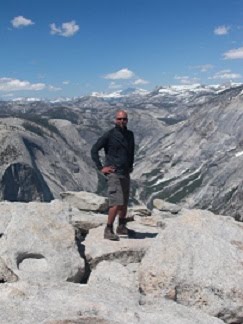
It might not have required the same concentrated exhaustion of Half Dome in Yosemite or indeed of some of the volcanos I have climbed on my way down through Central America earlier in my travels, but there was definitely a really sense of satisfaction and achievement in standing above Ciudad Perdida after four days, twelve hours of walking, and about forty sandfly and mosquito bites on my legs. We hiked in rain, walked through ankle-deep mud and waded through waist-high to get here, and the memories I have will remain with me forever.
Labels:
Ciudad Perdida,
Colombia
Friday, 15 October 2010
CIUDAD PERDIDA HIKE - DAY 3
I didn't sleep well last night, too hot in my sleeping bag, too bothered by the loosely hanging mosquito net around me draping over my face like a shroud. I grimace when one of the guide wakes us around 6AM. We rise early, in order to finish our days walking before the daily afternoon rain in the jungle begins.
Mosquitos have the reputation, but it seems to be sand flies that are doing the most damage, the lower halves of my legs a dot to dot of blood spots from not putting on long trousers as soon as we arrived in camp yesterday.
After breakfast, we head off, edging nervously along thun lycen-slimed rock platforms high above above almost sheer vertical drops. The river roars threateningly below us, a stark reminder that getting to Ciudad Perdida is not a given. We cross the river four times, but my boots and socks are still dry at the end of the three hours of walking in which we stopped only for a dip in the river or a slice of pineapple.
We arrive at camp before midday, and after a quick lunch of luncheon meat, queso and rolls, relax under a waterfall flowing into the river beside our camp, enjoying the last of the sun before the predictable rain clouds start to gather. Our camp for this evening is one hour and 1200 steps from Ciudad Perdida. We will find the Lost City tomorrow.
Labels:
Ciudad Perdida,
Colombia
Thursday, 14 October 2010
CIUDAD PERDIDA HIKE - DAY 2
We rise at 6AM after our first night out in the jungle, to visit a local coke factory before we start the days hiking. If I am expecting underground tunnels and rows of microwaves and test tubes being worked by mask-covered workers, I am disappointed. Instead we visit Mario and his one-man tourist operation, for a walk-through of the coke-making process from raw coca leaves to the finished powdered product. Apparently, six chemicals are needed to turn the leaves into coca paste, and a further four to turn it into powder. Apparently Colombians most infamous export leaves the jungle factories in Northern Colombia as 100% pure cocaine paste, bound for Santa Marta to be turned into 10-20% pure powder and either sold to tourists or shipped overseas. Apparently, those that want to can enjoy a free sample after the tour, and make a purchase from his gift shop if they like it.
****
We swim in crystalline rock pools during rest stops. The scenery around us is 'Gorillas in the Mist', the indigenous locals straight out of the 'Emerald Forest', the weather and terrain similar to that when Michael Douglas rides down a landslide in 'Romancing the Stone'.
- 'This certainly beats sitting in an office in London.' I remark casually to James the ex- Coutts fund manager.
- 'Yeah Man.' he replies blithely. Its all that really needs to be said.
****
I havent learnt a new card game in several years, but tonight we are introduced to Yanneth by James the Englishman. It keeps two Irishwomen, a Scotsman, an American and a German couple entertained for many hours as the sun goes down and the fire flies start to dance in the darkness. Perhaps its the camaraderie of internation bonding that keeps us all up long after we all start feeling tired, or perhaps its the mouldy bed mattresses that await us in our second night of sleeping out in the jungle.
Labels:
Ciudad Perdida,
Colombia
Wednesday, 13 October 2010
CIUDAD PERDIDA HIKE - DAY 1
- 'Do you think there are any parasites in this river?' Loren the Dubliner enquires as she lowers herself into the rock pool to swim.
- 'Only the Irish.' I inform her.
Lauren the Dubliner and Jen the Donegal Lass both laugh politely, whilst everyone else in our trek group to the Lost City laughs louder. The three of us are traveling with James from Essex, who says 'Like' and 'Yeah Man' quite a lot for someone that has spent the last seven years working as a fund manager for Coutts in London. Apparently he managed a three billion pound fund before he quit his job, grew a beard and went travelling. John is a bike messenger from Seattle. He has long blond hair, knows the names of all the best types of marijuana sold around the world, and openly admits early on that he hasn't had a shower for three days before the trek began. Celine and Mogitz are a couple from somewhere in Germany that I havent heard of, but that is close to someone else in Germany that I also havent heard of. The final member of our group of eight is a gordita Colombiana called Patricia from Bogota. She is the only one that I am not sure will reach the Lost City, as she already has the guides carrying her rucksack before we even start the trek.
The first 30 minutes of our five day hike to Ciudad Perdida, we tiptoe over rivers and through mud in the sun. Whilst we are cooling in a small rock pool that I hope doesn't have any parasites in it, it starts to rain. The next 3.5 hours are spent walking in the Colombian jungle in torrential rain. Ciudad Perdida beckons. So does a night sleeping in a hammock in soaking wet clothes.
Labels:
Ciudad Perdida,
Colombia
Tuesday, 12 October 2010
UNTIL NEXT TIME, FAIR LADY BOGOTÀ
Bogotá, you treated me well. You showed me kindness and honesty, reminded me of the importance of friendship, and taught me that there really is more to life than the one I was living. I leave you with a heavy heart, but bid you not a sombre 'Adios' but instead a optimistic 'Hasta pronto'.
From the day I arrived, the city shattered all preconceptions and unfair media stereotypes that I had in my head about Colombia. The locals were honest, and didn't all try to rob me; in fact, the only crime I was a victim to in Bogotà was a taxi driver that charged me three times the normal fare late one evening, when I stumbled into the back of his yellow car after a little too much aguardiente. Likewise, Colombians are not all drug smugglers working in the cocaine industry; indeed, the only time I came into any contact with the countries white powder in Bogotà was when Karl the English volunteer stumbled into the gents toilet in a salsa club to find someone shovelling it up his nostrils, seemingly without a care in the world for who saw him.
I never felt unsafe in Bogotà, even when walking the streets late at night by myself, and was indeed surprised to discover that the police and military presence in Colombia's capital is in fact far less than it was in Mexico, El Salvador and Guatemala, and indeed most of the countries I have visited so far on my travels. Colombia's political focus on security in recent years is clearly working.
Unfair stereotypes of a drug and crime-ridden city dismissed, there was much to like about Bogotà. I definitely liked that there was so much to do, and so many things to see. The city launched an extensive new tourism advertising campaign whilst I was there, and it certainly didn't surprise me; the tourist attractions in and around the capital are as varied as those in any big city I have visited around the world.
I also liked the people. A lot. I liked that the locals liked to help extranjeros looking bewildered at Transmilenium bus maps in their first few days in the city, and I liked that the female of the species liked to dance with me in Salsa clubs, even when I stood on their feet. I didn't like that a few of them thought I was a Gringo.
I liked that Bogotà's high altitude location means there is really only one season all year round and that it is generally never too hot nor too cold in the city, although I did dislike that I could be getting mild sunburn one minute, and soaked in a torrential downpour the next.
I liked that I could travel across almost the entire city by bus for less than fifty pence, and that cheap taxis were everywhere and there was no charge when the yellow vehicles inevitably got stuck in a traffic jam. I liked the modernity of the transport network (and that a Bogota Metro system is coming in the future), but also that the occasional horse and cart could still be seen riding alongside the Transmilenium bus lane. I liked that all car commuters are forced to take public transport into work two days a week, in a civic bid to cut down traffic congestion in the capital, but didn´t like that it wasn´t really working, and still resulted in overcrowded buses during peak rush hour. I liked that certain roads shut down to vehicles each Sunday across the capital so that cyclists, runners and roller-bladers can take to the city centre streets to exercise safely, and I liked that the mountain range, and Monserrate in particular, acted as a point of reference whenever and wherever I was walking on foot, making it difficult even for extranjeros with a terrible sense of direction from getting lost in the city sprawl.
I liked the fairness in the wealth system, that rich people have to pay more for their electricity and water bills than poor people, a subsidy system based on the geographical location of the household resulting in luxury apartments in upmarket areas paying more more than the poorer people living in the outskirts of the city.
I liked the lively restaurant and bar scene in Zona Rosa, but I also liked that you could sit and drink a cheap beer (for the equivalent of 50 pence) in the equivalent of a British corner shop, across the entire city. And I also liked that the shop owner wouldn't collect any of the empty bottles from your table until you finished drinking, paid and left, although I did like less that a lot of the tables in the poor areas of Soacha were often overflowing with bottles by 11AM.
I liked that a trip to the cinema cost 4500 pesos (GBP 1.50), but I didn´t like that my Scottish bank card was not accepted by many Colombian bank ATMs, and that the ones that did decide to give me money took a 5% commission. That said, I did like that you "entrar y retirar" your bankcard in Colombian ATMs, so there is no chance of your card disappearing forever when you forget your PIN after too much aguardiente.
I liked that the Juan Valdez coffee chain is the most popular caffeine fix in Colombia (and that Starbucks doesn't get a look in), and I definitely liked that I could enjoy a high-quality meal in Crepes and Waffles for a similar outlay to the extortionately priced Golden Arches. I also liked the laid-back Sunday market at Usuquèn, although I did like less that you could buy a cute puppy out of a holdall bag.
And of course, I liked my volunteering in Bogotà with Emerging Voices. There was genuine pride in wearing the orange 'voluntario' t-shirt or green Soacha gilet when I left the volunteer apartment in the morning, and a real sense of pleasure in arriving at the school or orphanage and having children running towards me with a smile and a shout of 'Ross' or 'Hola Profe (teacher)'. The volunteer work I have been doing in Bogotà over the last few weeks has definitely been as personally rewarding as anything I have ever done, and the experiences, particularly those at the orphanage, have reminded me of many things that have been missing in my life, and taught me many things that I had not known or thought to learn.
I've thoroughly enjoyed my time in Bogotà, and take away some wonderful memories. The slogan underpinning a current Colombian international tourist campaign is that 'the only risk in the country is wanting to stay', and after only six weeks in the countries capital, this is something I can definitely relate to. Leaving Bogotà is hard, but I know I will be back before too long, after a few weeks seeing the rest of the country. I currently have a reason to come back, and someone to come back for. Only time will tell what, if anything, lies in store for me and the special Colombiana that I have spent a large part of the last few weeks with, but I am certainly looking forward to finding out.
Monday, 11 October 2010
A NICE MORNING TALKING TO DRUG SMUGGLERS AND MURDERERS
Getting into La Picota prison in Bogotà is almost as difficult as getting out. It took two failed planned visits last week, and a passport check, three stamps on my hands, two body searches, one finger-printing and a labrador sniffing in my groin today to finally get into talk to some of the inmates in one of Colombia's most dangerous prisons.
Piso 5-6 is filled with drug smugglers, mainly Colombians but also a few extranjeros, who do not get (m)any visits....
Andy from Manchester is in prison for three years. It is his first time in the clink, after 15 years in "the industry". Although he has already paid off his mortgage back in Blighty and was wearing shiny trainers that I noted were newer than mine, he told me he was getting out of drug smuggling when he finishes his current sentence.
Maphu from Slovakia had pupils like pinholes when we arrived, having apparently been in a party spirit for the last few days. He is doing 11 years for drug smuggling, but has already completed four years of his sentence and is hoping to be out in two years for 'discounts' (good behaviour). It's his second time in prison, but despite also wearing newer trainers than me, says he is planning on getting out of "the industry" when he gets out, and settling down with his Colombian girlfriend.
Marvin the Mexican was from Tijuana and is also in for drug smuggling, but he preferred to talk (and have his photo taken with) the female volunteers, so I didnt find out too much about him.
There was also a moustachoed Mexican from Sinalao, whose name I didn´t catch, and whose committed crime I didn`t ask, mainly because he had a moustache and I had a feeling he might not be in the same "industry" as the others.
Andy, Maphu, Marvin and Moustachioed Mexican Man seem to have it quite easy in La Picota. There are only 120 inmates in Piso 5-6, compared with 400-500 convicts in the other prison blocks; there are also only two people to a cell, a television in the prison yard, and all inmates with enough pesos are allowed a weekly visit from a lady of the night (on a Sunday afternoon).
On the downside, the food looked shit, recreational / educational activities almost non-existent and the showers are apparently cold. I didn´t ask any of the inmates if they had to share their soap.
The prison yard in Piso 5-6, La Picota
The carpentry workshop in La Picota prison
Marvin the Mexican wanted his photo taken with the ladies
L-R: Melvin the Mexican drug smuggler, Josh and Nic (volunteers), Maphu the Slovakian drug smuggler,
the Moustachioed Mexican whose crime remained unknown, me, Andy the Mancurian drug smuggler
Saturday, 9 October 2010
SATURDAY NIGHT AT ANDRÈS CARNE DE RES
Arriving at Andrès Carne De Res restaurant in Chia is a little like arriving in Las Vegas, except without the fruit machines. The lights are bright, the decor outrageous, and the music and crowds of people are both in a loud and party-going spirit.
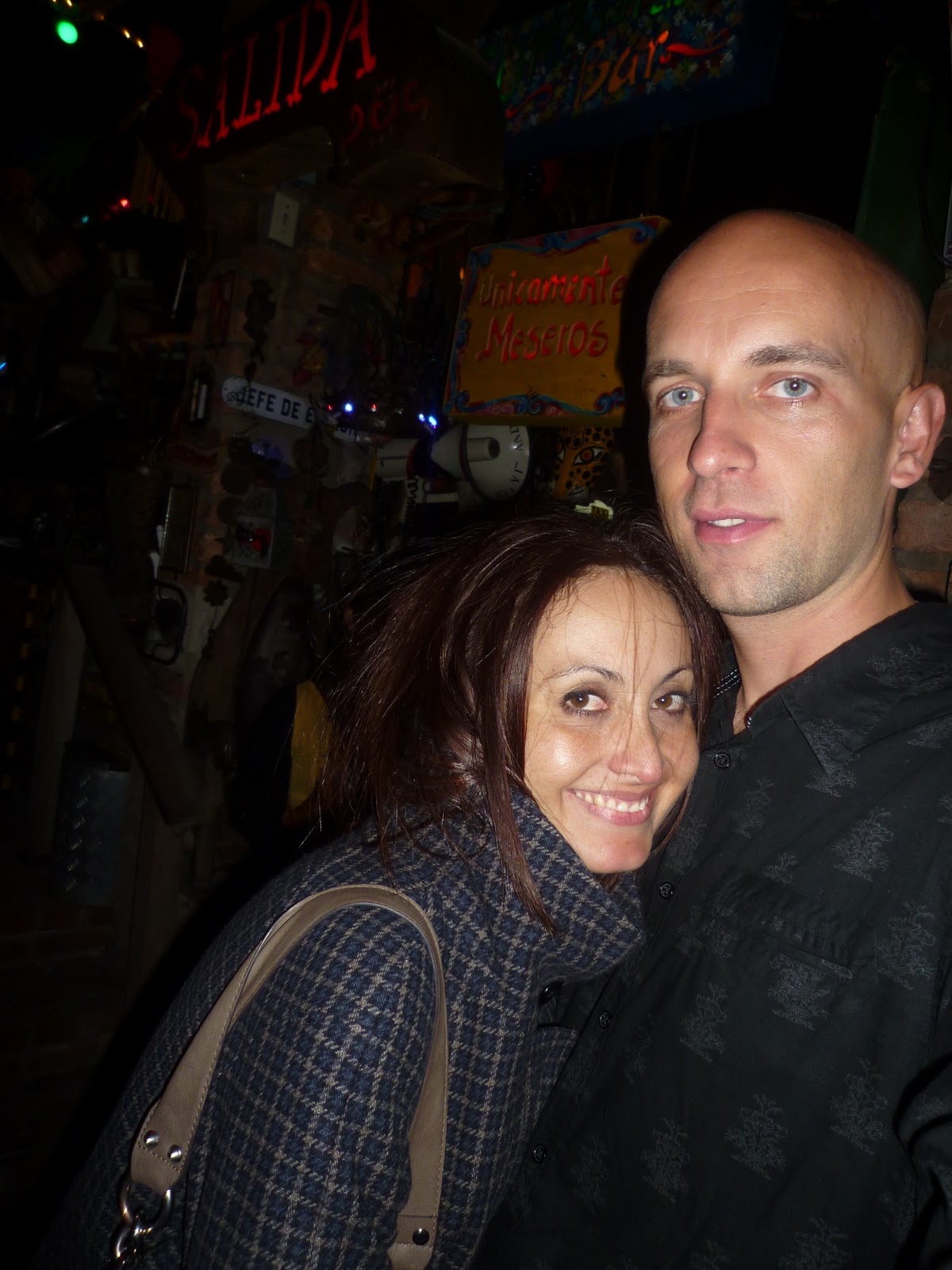
We drunk (a little), we danced (a lot), but mainly Gloria and I just enjoyed our last Saturday night together in Bogotà.
Friday, 8 October 2010
A SAPO (FROG) IN BOGOTÀ
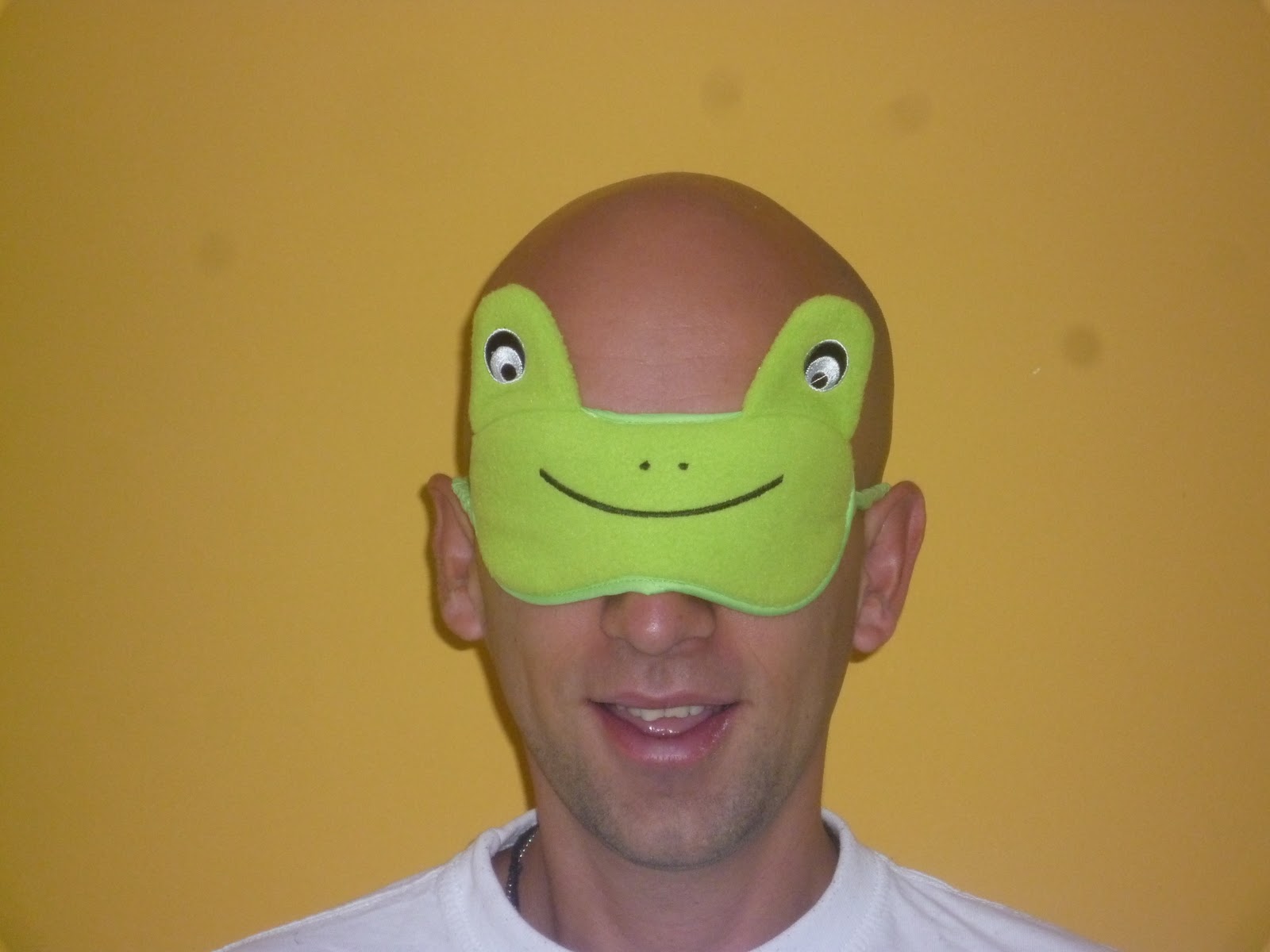
- 'Guess what animal.' Gloria challenged me with a smirk. I had been complaining about always being woken by Colombian sunlight shining through light-weight Colombian curtains, so she had surprised me with a regalo (present), an eye mask in the shape of an animal.
A roaring lion. I immediately imagined. Or an elephant or rhinoceros. Definitely some sort of manly jungle animal to cover my eyes and keep me sleeping soundly when dark becomes light in the early hours of a Bogotàn dawn.
- `Wrong.` Gloria shook her head with another smirk.
Ribbit
FEEDING THE HOMELESS ON MY LAST FRIDAY IN BOGOTÀ
Today was five weeks to the day since I last went to the Macarena to help feed the homeless people, and I decided to head back to help the Hermanas Misioneras de La Caridad nuns for my last Friday in Bogotá.
Last time I thought I was peeling leeks, but this time I found out they were actually onions, when I asked a local woman what the Spanish word for leek was. Perhaps I should have known better when my eyes started watering, but then again, Colombian fruits and vegetables can be extremely confusing. Earlier in the week, my mouth hung open when I accompanied a friend to a local fruit and veg shop, as I stared incredulously at the sheer variety of fruit and veg on offer, all with weird and wonderful names such as maracuya, tomate de arbol, balues, lulo-naranjilla, golupa, guatila, mamey, yacon, papaya, guanabana, chontadura, noni, higos, curuba, badea, nispero, chirimoya, carambola, papayuela, guayava, mama-Sapote, cimarrón-culantro, granadilla and pithaya.
As I helped serve plates of rice, corn on the cob casserole and a boiled egg to the waiting homeless people, I reflected quietly to myself that in many ways the last five weeks of volunteer work have gone really quickly, whilst in other respects, it seems like I have been living in Bogota for a life-time. Its fair to say that I dont think my eyes were only wet from the onions as I enjoyed my last Friday in Bogotà.
Thursday, 7 October 2010
Wednesday, 6 October 2010
FEEDING THE HOMELESS AT NIGHT IN BOGOTÀ
- 'No soy Gringo.' I politely corrected one of the homeless people as he waited patiently outside the minivan for me to pour him a cup of hot chocolate. It was about the only lighthearted thing that I said whilst feeding the homeless in central Bogota tonight, asides from an initial laugh when one of the nuns called Rose thought that I had the same name as her.
All in all it was a sobering experience, watching large numbers of homeless people running towards us whenever we shouted 'pan y chocolate' (bread and hot chocolate) out our minibus window, and then watching drug addicts, transvestites, even children lining up in an orderly queue, and then thanking us, the nuns and God for the bread and hot drink that we served them. Seeing it makes me thankful for what I have, and glad to have somewhere dry and warm to sleep tonight, and a hot breakfast being cooked for me when I wake up tomorrow morning. The homeless people that I saw tonight have none of that, and less. A lot less.
Tuesday, 5 October 2010
SO NEAR BUT YET SO FAR AT LA MODELO PRISON
Today, I was supposed to visit a prison in Bogota to talk to drug smugglers, murderers and rapists. The trip to visit foreign nationals incarcerated in La Modelo, Colombia's largest prison, has been in the pipeline ever since I arrived in Bogota, other volunteers rather annoyingly having gone the week before I arrived.
After several weeks of false dawns, disappointments and a vow of silence from the prison officials that needed to authorise our trip, our visit had finally been rubber-stamped and set up for this morning. The volunteers set off early (notably, a lot earlier than we ever all leave to go to the orphanage, school or to feed the homeless), letter of written permission and two forms of ID in one hand, pot noodles and chocolate bars for the prisoners in the other.
We made it down to south Bogota where La Modelo prison is located on time. We made it through the front entrance to the prison, past the school where the children whose both parents (there is a mans prison and a womans prison) are in prison go to, and past the flash new prison wing where convicted politicans live in isolated luxury. I even made it past the initial ID security check to the point of getting my hand marked with an ink stamp, when the heartbreaking bad news was broken to us:
A security incident would unfortunately mean we would not be able to enter the prison today (and probably not this week).
To say I am gutted is an understatment. It is a massive disappointment, summed up beautifully by Jenn the Irish girl when she announced on the bus-ride home (after comfort-eating the chocolate bars she had brought for the inmates) that she felt nearly as bad at not getting into the prison as she had felt when France's Thiery Henry scored with his hand against Ireland in a World Cup qualifier last year.
Personally, I feel nearly as bad as whenever England win at anything. However that said, I had a sneaky suspicion all morning that our visit was going to go 'barriga' (belly) up at some point, after noticing when the prison guard was entering my personal details into his computer, that the IT system La Modelo prison is running on is Oracle-based and not SAP.
The disappointment amongst Irish and Scottish volunteers was evident
Footnote: Al and Josh, if you happen to read this, thanks A LOT for your ongoing efforts to get Jenn and I into the prison before we leave, its REALLY appreciated.
Sunday, 3 October 2010
A RELAXING SUNDAY, WITH GLORIA IN GUATAVITA
Gloria and I might not have solved the mystery of El Dorado at Laguna de Guatavita today, but we did have a relaxing Sunday together in the Colombian countryside.
-----------
There were black and white cows, purple flowers and a grey sky that threatened rain.
It could have been Scotland, but it was actually a 45-minute drive outside of Bogota.